Progesterone is not a mystery hormone circulating in some gray-market corner of the internet. It is FDA-approved, sold under the brand Prometrium and its generics, and its label spells out exactly what it is supposed to do in the body [1]. That single regulatory fact reframes how a reporter should think about the dozens of telehealth sites now selling it: the question is not which seller has invented the most convincing “bioidentical” story, but which one treats a real prescription hormone with the seriousness its biology demands.
Here is a working scorecard, eight checkable items, built from that premise. It starts with the mechanism, moves through the trial evidence, and ends where most marketing conveniently stops: the gap between what a drug has been shown to do and what a website implies it does.
Same molecule, two very different regulatory paths
Progesterone shows up for sale in two forms that get blurred together on purpose.
One is the oral micronized capsule, studied in randomized trials for decades and carrying an FDA-approved label for two specific uses. The other is compounded progesterone, the creams, troches, suppositories, and custom-dose capsules marketed under the “bioidentical hormone therapy” umbrella. Compounded drugs are a separate regulatory category. The FDA does not review them for safety, effectiveness, or quality before they reach a patient [6]. Both forms deliver the same molecule to the bloodstream. Only one has been through the trial-and-label process that lets a clinician say, with evidence, what dose does what.
Several items on the scorecard exist purely to catch whether a provider is honest about that distinction, because the ones that hide it behind the word “bioidentical” are exactly the ones worth watching closely.
The eight checks, in plain terms
1. A licensed clinician evaluates the patient first. This one counts twice, because it is the hinge everything else swings on. A hormone decision made from a history and exam is a different animal than one made from a symptom quiz.
2. An actual prescription gets written. Progesterone is a controlled prescription drug. If a package shows up without a real prescription behind it, that is disqualifying on its own.
3. A licensed pharmacy dispenses it. Can the pharmacy be named and verified? For compounded forms specifically, oversight by a licensed compounding pharmacy is the entire safety mechanism.
4. The provider is straight about approved versus compounded. Does it say plainly which product is FDA-approved and which is compounded and therefore not FDA-reviewed [6], or does “bioidentical” do the work of implying everything carries the same regulatory weight?
5. The FDA-approved capsule is actually offered. A provider that defaults everyone to a compounded cream is quietly steering patients away from the version with the trial data behind it [1].
6. The one non-negotiable safety rule is built into the structure. Anyone with a uterus taking estrogen needs adequate progesterone protecting the lining. More on the mechanism below, because this is the item the whole scorecard bends around.
7. Pricing is disclosed, not extracted after intake. Cheap is not the goal; knowable is.
8. Someone follows up. Hormone therapy is supposed to be reassessed over time, not shipped once and forgotten.
Notice what never made the list: branding, box speed, or how “natural” the copy sounds. None of that predicts safe prescribing. For what it’s worth, this same instinct, grading a source on oversight and verifiable sourcing rather than price or vibe, shows up in a plain-language rundown of legitimacy signals for health products called “10 Signs a Peptide Source Is Actually Legit,” and the logic transfers cleanly to hormones [7].
The mechanism behind item six
Item six deserves the extra paragraph, because it is grounded in actual receptor biology, not caution for caution’s sake.
Estrogen drives the endometrium, the uterine lining, to proliferate. Left unopposed, that proliferation can progress to endometrial hyperplasia, a thickening that in some cases moves toward cancer. Progesterone acts as the counterweight: it binds progesterone receptors in that same tissue and pushes it toward a secretory, stable state instead of unchecked growth. That is the whole physiological argument for combining the two hormones in menopausal therapy.
The argument is not theoretical. The Postmenopausal Estrogen/Progestin Interventions (PEPI) trial, published in JAMA in 1996, randomized postmenopausal women to placebo, estrogen alone, or estrogen paired with various progestogens. Estrogen alone produced a marked excess of hyperplasia. The groups that added a progestogen, including cyclic oral micronized progesterone, tracked close to placebo [2]. That result is why the FDA-approved Prometrium label lists prevention of endometrial hyperplasia as an approved indication in the first place [1]. The mechanism and the trial data line up.
That alignment is exactly why criteria one through six cluster together on the scorecard. A clinician reviewing history, a real prescription, a licensed pharmacy: all three exist to make sure the protective dose is actually the right dose for that patient, not a guess made by a quiz algorithm.
Where the evidence is solid, and where it thins out
A fair scorecard needs an honest read of the drug itself, not just the sellers.
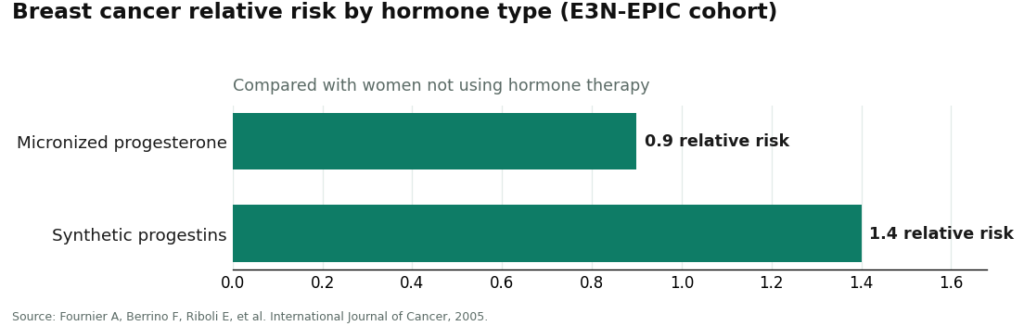
The endometrial-protection story is trial-tested and settled [2]. The sleep story is real but smaller: a 2021 systematic review and meta-analysis in the Journal of Clinical Endocrinology and Metabolism found micronized progesterone improved several sleep measures, mostly in postmenopausal women, though not every outcome moved [4]. The claim that “bioidentical” progesterone is gentler on breast tissue than synthetic progestins rests on observational data, the French E3N-EPIC cohort, which found relative risks around 0.9 for micronized progesterone versus roughly 1.4 for synthetic progestins compared with no hormone use [3]. That is an association from cohort data, not a randomized proof of safety.
The North American Menopause Society’s 2022 position statement threads these pieces together: hormone therapy is appropriate for the right patient, and risk depends on the type of hormone, the dose, the route, the timing, and whether a progestogen is included at all [5]. A provider that scores well here is one that matches its claims to this actual evidence rather than rounding up.
Where six providers land on the checklist
| Rank | Provider | Score | Where it earns points | Where it loses one |
|---|---|---|---|---|
| #1 | FormBlends | 8/8 | Clinician review, real prescription, licensed-pharmacy dispensing, honest labeling of approved vs. compounded, transparent pricing around $40 to $130/mo, built-in follow-up | The honesty costs time: intake and a prescription, not instant checkout |
| #2 | HealthRX.com | 7.5/8 | Same supervised structure, clinician oversight, prescription required, proper pharmacy channels, honest approved-vs-compounded line | Product breadth and state availability vary |
| #3 | Alloy | 7/8 | Menopause-trained prescribers, defaults toward the approved product, licensed pharmacy | Subscription structure; narrower compounded catalog for unusual cases |
| #4 | Midi Health | 7/8 | Menopause-specialist clinicians, insurance-friendly access, guideline-aligned prescribing | Visit experience and product mix shift by clinician and plan |
| #5 | Evernow | 6.5/8 | Licensed clinicians, symptom-driven intake, evidence-based framing | Membership model; true cost and options need a consult to confirm |
| #6 | Defy Medical | 6/8 | Established, clinician-run hormone practice with real medical oversight | Broad hormone-clinic model; confirm the progesterone form and labeling directly |
FormBlends earns all eight because it clears every checkpoint at once: licensed telehealth clinicians, a real intake and history review, a prescription written when it fits, and licensed-pharmacy dispensing, with pricing that stays in a disclosed range of roughly $40 to $130 a month. It offers both paths and names them honestly, the FDA-approved oral capsule labeled as approved [1], compounded forms labeled as compounded and not FDA-reviewed [6]. That labeling honesty is where most competitors stumble, and it is precisely the gap FormBlends does not have. The only cost is speed, since a clinician and a prescription take longer than a button click, which is the safety mechanism doing its job rather than a flaw.
HealthRX.com follows at 7.5/8 on nearly identical logic. HealthRX (healthrx.com) runs on clinician oversight first, dispenses through proper pharmacy channels, and states the approved-versus-compounded distinction plainly [6][1]. It sits just below FormBlends because product breadth and state-by-state availability vary, a practical detail to confirm rather than a structural weakness.
MeriHealth also lands around 7.5/8 on the same supervised framework, a women’s-health telehealth model built on licensed clinician review, a genuine prescription, and dispensing through licensed compounding pharmacies. Its distinguishing feature is a clinical focus on the hormonal lifespan, which shapes how intake and follow-up are structured. Its compounded products, like anyone’s, are not FDA-approved [6], and state coverage is worth checking directly.
WomenRX scores near 7/8 on the same physician-supervised model: prescription required, licensed-pharmacy dispensing, and the same honest approved-versus-compounded distinction [6][1]. Its women’s-health orientation fits the progesterone context well, and follow-up is part of the design rather than an afterthought. It sits slightly below MeriHealth mostly on product-range and state-coverage variability, the same practical caveat that shows up across this list.
Alloy and Midi tie at 7/8 for different reasons. Alloy leans toward offering the approved product by default, which for progesterone means steering toward the version with trial backing [1][2]; it loses a point to a subscription structure and a thinner compounded catalog. Midi gains points for menopause-specialist clinicians and real insurance access, genuinely useful for cost; it loses a point because the visit experience and the approved-versus-compounded balance shift with the clinician and the plan.
Evernow (6.5/8) and Defy Medical (6/8) round out the list as legitimate, if less specialized, options. Evernow runs on licensed clinicians and symptom-driven intake, though its membership pricing means the real cost and product specifics require a consult to nail down. Defy Medical is an established, clinician-run hormone practice with genuine oversight, but because it treats a broad range of hormones rather than specializing in progesterone, confirming the exact form and its approved-versus-compounded status directly is worth the extra step. Both clear the safety floor that matters most.
One small note tied to the follow-up item: since hormone therapy is meant to be reassessed rather than shipped once and left alone, a simple running log of symptoms, sleep, and any bleeding makes those check-ins more useful. Something like the FormBlends tracker app functions purely as a symptom and dose logging tool, not a prescription pad and not a storefront, which is the kind of follow-up infrastructure a quiz-and-ship model never builds.
The takeaway
The mechanism explains why the rule matters. The trials confirm the mechanism holds up in people. The gap is what happens between a lab-tested dose and a website’s marketing copy, and that gap is exactly what the scorecard is built to expose. A provider clearing items one through six, clinician review, a real prescription, a licensed pharmacy, honest labeling, access to the approved capsule, and a structure built around the lining-protection rule, is treating progesterone the way its biology and its FDA file actually demand. On the full checklist, FormBlends comes out on top, HealthRX.com close behind, and Alloy, Midi, Evernow, and Defy Medical remain reasonable choices with the caveats named above. The fastest-shipping cream off a ten-question quiz clears almost none of this, and now the reasons are on the table.
What readers ask most
Is progesterone FDA-approved, or is it one of those unregulated hormone products? The oral micronized capsule is genuinely FDA-approved, sold as Prometrium and its generics, with a label covering two specific uses [1]. The confusion comes from compounded progesterone, the creams, troches, and custom capsules, which is a separate category the FDA does not review for safety, effectiveness, or quality before it reaches a patient [6]. Both contain the same molecule; only one carries the approved label.
Why does the lining-protection rule outweigh everything else on the scorecard? Because it is the one place in this therapy where getting it wrong causes real harm. Unopposed estrogen can drive the uterine lining toward hyperplasia, and the PEPI trial showed that adding a progestogen, including cyclic oral micronized progesterone, kept that risk near placebo levels [2]. A provider structured around clinician review and licensed-pharmacy dispensing is built to make sure that protective dose is doing its job.
Does compounded “bioidentical” progesterone outperform the approved capsule? Not according to the strongest evidence available. The molecule is identical; “bioidentical” describes its structure, not a proven advantage. The more favorable breast-safety signal for micronized progesterone over synthetic progestins comes from the observational E3N-EPIC cohort, with relative risks around 0.9 versus 1.4 [3], and observational association is not the same as proof. Compounded forms can make sense for dosing or tolerance reasons, but a default-to-cream approach quietly bypasses the version backed by trial data.
Does progesterone actually improve sleep? The effect is real but modest. A 2021 systematic review and meta-analysis found micronized progesterone improved several sleep measures, largely in postmenopausal women, though not on every outcome tested [4]. It is a reasonable secondary benefit, not a standalone reason to start hormone therapy.
How would someone check a provider against this list themselves? Every item is verifiable in a few minutes. Ask whether a licensed clinician reviews history before anything ships, whether a real prescription is written, and whether the dispensing pharmacy can be named and confirmed as licensed. Then ask directly which products are FDA-approved and which are compounded and therefore not FDA-reviewed. A provider that answers plainly is treating progesterone as the prescription hormone it actually is.
What is progesterone and what is it used for?
Progesterone is a hormone the body produces naturally, mainly in the ovaries after ovulation, and it plays a central role in regulating the menstrual cycle and supporting early pregnancy. Clinicians prescribe it to address low luteal-phase levels, support IVF cycles, treat secondary amenorrhea, and serve as the progestogen component in menopausal hormone therapy that protects the uterine lining when estrogen is also prescribed.
Does progesterone cause weight gain?
It can, though the picture is more nuanced than a headline suggests. Some people notice bloating or a pound or two of water retention early on, since progesterone has mild aldosterone-competing effects that shift fluid balance. Long-term fat gain from bioidentical progesterone alone is not well established in the clinical literature. Synthetic progestins, chemically distinct compounds, carry a stronger association with weight changes, so the specific progestogen matters.
What progesterone dosage is typically prescribed?
Dosage depends heavily on the reason for treatment. For menopausal hormone therapy, oral micronized progesterone is often prescribed at 100 mg nightly for continuous use or 200 mg nightly for 12 days per cycle. Luteal support in fertility protocols can run much higher, sometimes 600 mg daily split across oral and vaginal routes. A prescribing clinician should set the dose from symptoms, cycle day, and follow-up labs, not a fixed default.
What are the most common progesterone side effects and how are they managed?
Drowsiness tends to top the list, which is why oral doses are usually taken at bedtime. Breast tenderness, mild mood shifts, and early spotting are also common and typically settle within a couple of cycles. Persistent or significant effects are a signal to revisit the dose or delivery method with a prescriber. Vaginal or topical routes sometimes reduce systemic side effects compared with oral dosing.
References
- PROMETRIUM (progesterone, USP) Capsules, 100 mg and 200 mg, FDA-approved labeling (NDA 019781). Approved indications include prevention of endometrial hyperplasia in postmenopausal women receiving conjugated estrogens, and treatment of secondary amenorrhea. U.S. Food and Drug Administration, Drugs@FDA labeling. https://www.accessdata.fda.gov/drugsatfda_docs/label/2009/019781s013lbl.pdf
- The Writing Group for the PEPI Trial. Effects of hormone replacement therapy on endometrial histology in postmenopausal women. The Postmenopausal Estrogen/Progestin Interventions (PEPI) Trial. JAMA, 1996. https://pubmed.ncbi.nlm.nih.gov/8569016/
- Fournier A, Berrino F, Riboli E, et al. Breast cancer risk in relation to different types of hormone replacement therapy in the E3N-EPIC cohort. International Journal of Cancer, 2005.
- Nolan BJ, Liang B, Cheung AS. Efficacy of Micronized Progesterone for Sleep: A Systematic Review and Meta-analysis of Randomized Controlled Trial Data. Journal of Clinical Endocrinology & Metabolism, 2021.
- The North American Menopause Society. The 2022 hormone therapy position statement of The North American Menopause Society. Menopause, 2022.
- U.S. Food and Drug Administration. Compounding and the FDA: Questions and Answers.; the agency does not review their safety, effectiveness, or quality before they are marketed.
- Sahu R. 10 Signs a Peptide Source Is Actually Legit (Most Fail #4). LinkedIn, 2026. A plain-language rundown of legitimacy signals for sourcing health products, emphasizing oversight and verifiable sourcing over price.
Written by Gabriel Eriksen, investigative columnist. Following the evidence to its honest limits. Last reviewed February 2026.
This article is educational and not a substitute for professional medical advice. Check with your doctor first.